

Have you ever wondered how merciful our Creator is?
The Prophet ﷺ said, “When Allah completed the creation, He wrote in His Book which is with Him on His Throne, ‘My mercy has overcome My anger.’” (Bukhari 3,194)
Allah loves to forgive; He prefers to forgive His erring servants instead of punishing them. What He loves even more is His servants repenting to Him every time they commit sin, which is also a precondition to achieving His immense mercy.
“So glorify the praises of your Lord, and ask for His forgiveness. Verily, He is the One Who accepts the repentance and forgives.” (Al-Nasr 110:3)
He forgives all sins, no matter how numerous they might be. No transgression is beyond the scope of forgiveness, including all major sins. Hence, one should never despair of Allah’s mercy.
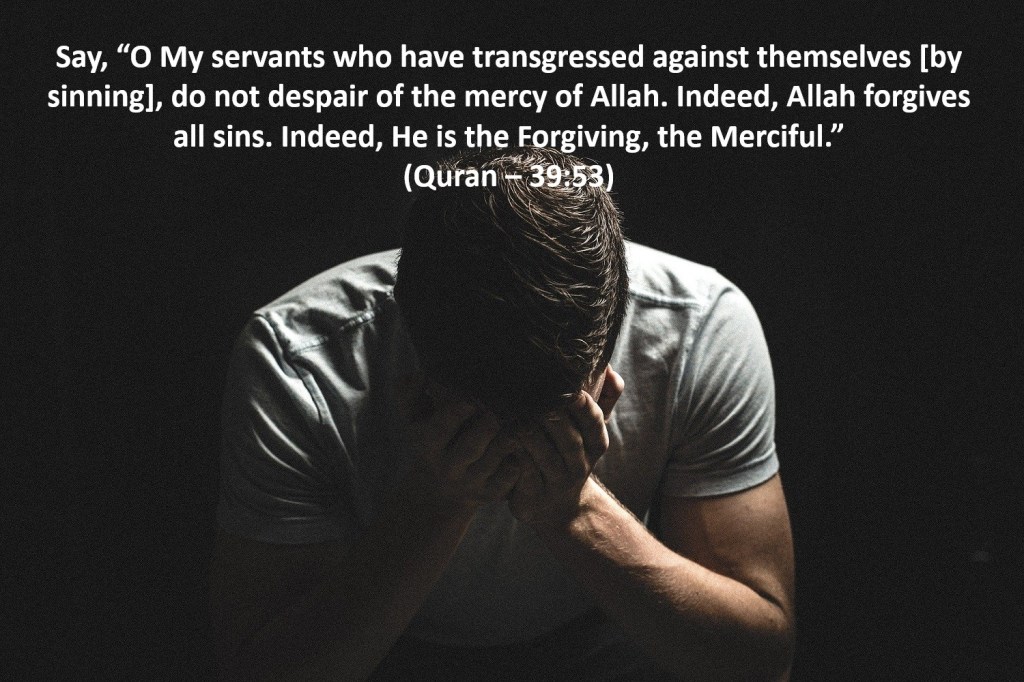
“Say, ‘O My servants who have transgressed against themselves [by sinning], do not despair of the mercy of Allah. Indeed, Allah forgives all sins. Indeed, it is He who is the Forgiving, the Merciful.’” (Al-Zumar 39:53)
Despairing of Allah’s mercy is sheer ungratefulness and a sign of disbelief. This is because His infinite mercy is a favor upon us, and denying any of His favors leads to ingratitude and weakening of one’s faith.
“…Certainly no one despairs of Allah’s Mercy, except the people who disbelieve.” (Yusuf 12:87)
He multiplies the reward of our good deeds by at least ten times and punishes each evil deed only once. Such is the justice He metes out to His servants.
“Whoever brings a good deed, he shall have ten like it, and whoever brings an evil deed, he shall be recompensed only with the like of it, and they shall not be wronged.” (Al-An’am 6:160)
We cannot avoid committing minor sins completely, nor does Allah expect us to do that. Instead, He wants us to seek His forgiveness and to humble ourselves to Him for every wrong we commit whether it is major or minor.
The Prophet ﷺ said, “By Him in Whose Hand is my life, if you were not to commit sin, Allah would have swept you out of existence and He would have replaced you by those people who would commit sin and seek forgiveness from Allah, so that He forgives them.” (Muslim 2,749)
Admitting our shortcomings to Allah, showing remorse over them, and imploring His forgiveness is a form of worship, and most desirable in His sight. He forgives us willingly and repeatedly.
The Prophet ﷺ said, “Allah, the Exalted and Glorious, stretches out His Hand during the night so that the people may repent for the fault committed from dawn till dusk and He stretches out His Hand during the day so that the people may repent for the fault committed from dusk to dawn. (He keeps accepting repentance) before the sun rises in the west (i.e. the Day of Resurrection).” (Muslim 2,759a)
Our wrongs do not affect Allah in any way; by disobeying our Creator, we go against our own innate nature (fitrah) and thus hurt our own souls. However, by repenting to Allah and being remorseful for our wrongs, we repair the damage caused to ourselves and win Allah’s pleasure.
Also read: How You can Help the People of Gaza
“And whoever does evil or acts unjustly to his soul; then asks forgiveness of Allah, he shall find Allah Forgiving, Merciful.” (Al-Nisa 4:110)
We are all sinful, to varying extents, and our good deeds alone will never be sufficient to make us enter Paradise in the hereafter. It is, in fact, Allah’s mercy that would augment our worthy deeds on the Last Day, and make us attain His good pleasure and the gift of Paradise.
The Prophet ﷺ said, “The good deeds of any person will not make him enter Paradise.” The companions asked, ‘Not even you, O Allah’s Messenger?’ He said, “Not even me, unless Allah bestows His favor and mercy on me.” (Bukhari, 5673)
In fact, Allah is the source of all mercy that exists. When we act mercifully towards one another, we exhibit a characteristic of Allah that He has bestowed upon His creations. Our feelings of affection and intimacy all stem from His great attributes of being the Loving (Al-Wadud) and the Merciful (Al-Raheem).
The Prophet ﷺ said, “Allah divided mercy into one hundred parts. He kept ninety-nine parts with Him and sent down one part to the earth, and because of that, its one single part, His creatures are merciful to each other, so that even the mare lifts up its hoofs away from its baby animal, lest it should trample on it.” (Bukhari 6,000)
Also read: Six Rewards for those who Seek Allah’s Forgiveness
We must sincerely invoke Allah’s forgiveness each day, for He is Al-Raheem (The Merciful), Al-Ghaffar (The Forgiver), Al-Ghaffur (The All-Forgiving), Al-Afuw (The Pardoner), and At-Tawwab (The Acceptor of Repentance). He is ever attentive to our pleas, and the extent of His mercy exceeds human comprehension.
The Prophet ﷺ said, “Allah the Almighty said: ‘O son of Adam, so long as you call upon Me and ask of Me, I shall forgive you for what you have done, and I shall not mind. O son of Adam, were your sins to reach the clouds of the sky and were you then to ask forgiveness of Me, I would forgive you. O son of Adam, were you to come to Me with sins nearly as great as the earth and were you then to face Me, ascribing no partner to Me, I would bring you forgiveness nearly as great as that.’” (Tirmidhi 3,540 – Hasan)
The content of this article is derived from the book His Mercy is Vast: A Practical Guide to Seeking Allah’s Forgiveness available for purchase globally.
 Islam Explained