

The lunar month of Ramadan is when Muslims fast each day from dawn till dusk. Fasting in this month is obligatory upon Muslim adults other than those exempted due to reasons such as sickness, travel, or pregnancy.
Staying without food and water for a substantial part of the day for a whole month can be difficult indeed. The length of each fast is typically 10 to 16 hours, depending upon the region and the season during which Ramadan falls. So why do Muslims undertake this strenuous activity every year? The answer is provided by the following verse of the Quran:
“O you who have believed, decreed upon you is fasting as it was decreed upon those before you that you may become righteous.” (Al-Baqarah 2:183)
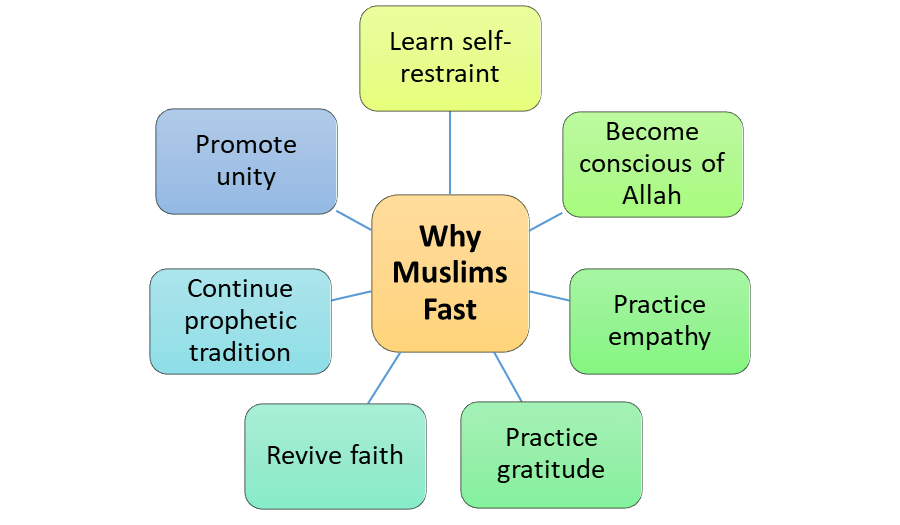
Hence, the primary objective for fasting is to attain taqwa – translated as becoming “righteous” in the above verse. While there are various health benefits associated with fasting, these are an added bonus or a by-product of fasting rather than a motivation behind it. The following are some of the reasons why Muslims fast during Ramadan and why it has so closely been associated with the concept of righteousness or piety.
1) Self-restraint
Fasting teaches people to control their urges and temptations. Refraining from all kinds of food, drink, sexual relations, and hurtful behavior while fasting allows Muslims to be in better control of their bodies and minds. Fasting, therefore, equips people with the patience and resilience needed to develop endurance and overcome new challenges. It inculcates a sense of discipline in them which they can build upon for the rest of the year.
2) Consciousness of Allah
Another connotation of taqwa is having fear of Allah. This, however, is not some irrational fear that must be overcome; rather, “fear of Allah” implies having a deep sense of consciousness of His presence which steers one away from wrongdoing and towards righteousness. Fasting revives the desire to please Allah and thus motives a Muslim to follow the path prescribed by Him.
3) Empathy
While the fasting person endures hunger and thirst for only a month every year, the poorest go through such an ordeal each day. Hence, fasting reminds people about the plight of the less fortunate, which should motivate them to help the needy and those going through a lean financial patch. By pondering the hardships faced by fellow humans and experiencing their plight, people develop qualities such as empathy and compassion which makes them better humans.
4) Gratitude
Fasting encourages a person to be thankful to Allah for all the blessings and goodness they possess in life. By depriving themselves of food and drink, the ones fasting become consciously aware of the material benefits at their disposal which they typically take for granted. This awakens the spirit of gratitude towards Allah.
5) Revival of Faith
Ramadan provides a perfect opportunity to connect with Allah and revive one’s faith. Many Muslims engage in acts of worship such as reading the Quran, offering the voluntary night prayer (tarawih), and supplicating to Allah. Fasting also provides the opportunity for people to reflect and contemplate on the realities of life, their purpose of creation, and how they can strive for self-improvement.
6) Continuation of Prophetic Tradition
Fasting is an ancient religious practice that was prescribed upon previous nations too. Hence, by fasting an entire month, Muslims become the flag-bearers of this legacy of the earlier nations that were divinely guided. Specifically, it is a continuation of the tradition of Prophet Ibrahim (Abraham) and his descendants.
7) Sense of Unity
Ramadan creates a sense of unity and brotherhood as families and friends share the early morning and evening meals, and spend more time together than they typically do in other months. In fact, the whole Muslim community comes together for activities such as praying at night, distributing food to the needy, and listening to sermons. Such an environment promotes harmony and solidarity among community members.
Explore books by Ammar Awais





 Islam Explained
Beautifully explained! Fasting in Ramadan strengthens our connection with Allah and builds discipline, gratitude, and empathy.
Deepen your understanding of Islam and the Quran
LikeLike