
The term artificial intelligence sometimes evokes images of robots and gigantic machines taking over the world and causing havoc – as portrayed in the science fiction genre. In reality, though, artificial intelligence (AI) is simply the replication of human intelligence in machines. It is a branch of computer science that involves building systems and applications that perceive their environment and act accordingly. From smart digital assistants, such as Siri and Alexa, to self-driving vehicles, AI is increasingly becoming a part of daily life in the second quarter of the 21st century. The AI industry is expected to grow significantly in the coming years, and contribute USD 13–19.9 trillion to world GDP by 2030.
Benefits and Risks of Artificial Intelligence
Benefits
AI applications have greatly enhanced information access and benefitted various types of industries. In manufacturing, sophisticated machines continuously perform error-free tasks, including risky, repetitive, and boring jobs. In medicine, AI mapping and prediction tools are now being used to track the spread of diseases. AI-based technologies also help in predicting medical conditions and diseases such as breast cancer. In business and finance, AI is being adopted to detect fraud, manage securities portfolios, and facilitate marketing and customer care. Social media platforms are also using AI to identify fake news and dangerous content.
Also read: 10 signs of the Day of Judgement that may have already appeared
Moreover, AI chatbots such as ChatGPT and DeepSeek have revolutionized the way information is generated and presented. They are extensively being used around the world for tasks such as researching, writing, translating, summarizing, and proofreading. According to a recent study by OpenAI, ChatGPT is also being utilized for purposes such as tutoring, computer programming, data analysis, and creating images.
Drawbacks
The development of artificial intelligence typically incurs high costs. AI-based machines have replaced humans in various industrial jobs, and are further expected to disrupt employment patterns in the coming decades. Another concern is the potentially dangerous flaws in some AI products. For example, self-driving cars have caused numerous traffic accidents, killing several people in recent years. There is also the possibility that advanced robots could become too difficult to control in the future.
AI chatbots, while greatly assisting people, have also made them lazy, screen-addicted, and overly reliant on AI. People have begun using AI chatbots to do the “thinking” for them which has arguably diminished their creativity and ingenuity. AI chatbots can easily provide false information, and can even invent “facts” and make ridiculous claims – something known as AI hallucinations. They also lack emotional capacity – individuals who rely on AI chatbots for emotional support not only tend to become more socially isolated, but also have been known to cause self-harm following interactions with AI.
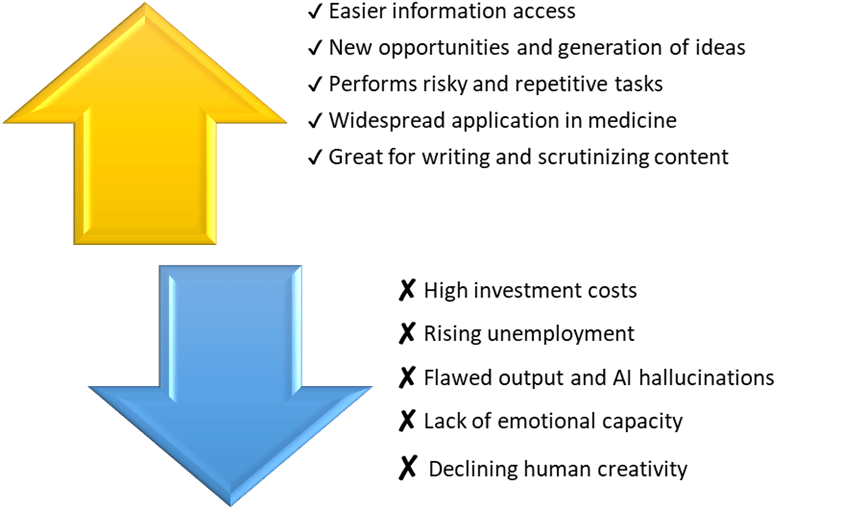
Figure 1: Advantages and disadvantages of artificial intelligence
Islamic Stance on Artificial Intelligence
General Permissibility
The stance of Islam on artificial intelligence is governed by a general principle: all new things, other than in matters of ibadah, are permissible unless there is specific evidence of their prohibition. Ibn Taymiyah, a renowned classical scholar and reformer, expounds upon this principal as follows:
“It should be understood that in principle all things, of various types and categories, are generally halal for human beings, and that they are tahir (pure) and it is not forbidden for people to handle them and touch them. This is a comprehensive rule that is general in application, and it is an important ruling that is of immense benefit and brings much blessing, and the scholars turned to it when issuing rulings on innumerable actions and issues faced by people.” (Ibn Taymiyah – Majmu Al-Fataawa)
There is no evidence to suggest that Islamic teachings either prohibit AI or outrightly discourage it. In fact, the Quran encourages people to make use of the resources at their disposal to benefit them in this life:
“And He has subjected to you whatever is in the heavens and whatever is on the earth – all from Him.” (Al-Jathiyah 45:13)
Elsewhere in the Quran, human-made objects and inventions, such as ships and coats of mail, have also been described as Allah’s blessings and signs. In the same way, AI applications and other products of human intellect can also be considered blessings of Allah that facilitate us in various aspects of life.
Warning against Misuse of AI
It is also important from an Islamic perspective to acknowledge and address the downsides of AI. For example, using AI to spread misinformation or create deepfakes, which means generating false images, videos, or audios that look incredibly real, is certainly sinful in Islam. Moreover, if such tactics are adopted to malign someone’s reputation, they amount to slander, which is among the most destructive sins in the sight of Allah. Similarly, showcasing the work generated by AI as one’s own is not only unethical but also a form of lying, which is again sinful.
The Quran also warns people not to “throw (yourselves) with your (own) hands into destruction” (Al-Baqarah 2:195). In this ayah, there is a stark warning against using AI to develop harmful technology or engage in addictive pursuits. Hence, AI should only be used in a way that is beneficial for humanity.
The Muslim World and Artificial Intelligence
A Rich Legacy
Islam lays great emphasis on learning and progress – something well embodied by our Muslim predecessors in the early centuries of Islam. From Al-Razi’s 9th-century innovative laboratory apparatus to the 13th-century water-raising machines invented by Al-Jazari, Muslims were at the helm of scientific and technological discoveries. In fact, the word algorithm, which is central to the structure of artificial intelligence, is derived from the name of Al-Khwarizmi, the 9th-century Muslim scientist and mathematician who first introduced this concept.
Also read: How You can Help the People of Gaza
However, in later centuries, and particularly since the colonization era, the intellectual decline of the Muslims has been all too obvious. In fact, the contribution of Muslims to the field of science and technology has been almost negligible in recent centuries.
The Need of the Hour
Today, Muslim countries need to invest in artificial intelligence, which can greatly uplift their economies and help overcome many of the challenges they face. The governments in Muslim countries need to incentivize AI startups, promote high-tech industry, and provide scholarships to students of STEM (Science, Technology, Engineering, and Mathematics). At the same time, aspiring students should look beyond the traditional fields of learning to the more innovative and emerging branches of science. Advancing technologically requires a culture of authentic research rather than mere book learning.
The potential for Muslims to excel in AI is undoubtedly there. AI-based ventures and entrepreneurs are thriving in several Muslim countries despite a lack of funding. These are just a few examples of impressive AI products and technologies developed by Muslims from different parts of the world:
- AI-based decision support algorithms for accurate cancer diagnosis – developed by Virasoft, a Turkish technology company.
- Police robots, known as PGuards, which were seen patrolling the streets of Tunis during Covid-19 lockdown – developed by Enova Robotics, a Tunisian startup.
- AI-based fire detection system, which is able to detect flames up to 10 meters away using only a color CCTV camera – developed by Pantau.ai, an Indonesian tech startup.
- Plug and play AI for crop diagnostics, which detects plant diseases, weeds, pests, and nutrient deficiencies – developed by DeepLeaf, founded by El Mahdi Aboulmanadel in Morocco.
- Intelligent tools for the visually impaired – a sewing machine called Pursewit developed by Aqsa Ajmal, and smart shoes for detecting obstacles along the way developed by Shanza Munir – both Pakistani graduates.
Such innovative inventions will hopefully inspire many Muslim scientists and entrepreneurs seeking to make their mark in the field of artificial intelligence and open up new horizons for them, InshaAllah.
Explore books by Ammar Awais




 Islam Explained
I swear to Allah, i summarised my point that how ai is destruction to humanity in Islamic way too, my comment wasn’t posted by itself and i copied it but it deleted from clipboard too.. that’s why I’m not telling all, just know that ai is a tool for arrival if dajjal by illuminatis satanic people, control us. . water..
LikeLike
You’re wrong brother please find out AI is a destruction to humanity in both ways, Elites plan to comtrol the world second water consumption
LikeLike
eBook: Islam and Futurology (20pages)
Read Online:https://www.slideshare.net/docsforu/e-book-islam-and-futurology
With the invention of Artificial Intelligence, Robots can now see, hear & talk with humans. So are robots “living”?
Has the Quran challenge of ‘creating a fly’ been met?
This booklet quickly and directly answers those questions.
Download:https://archive.org/download/eBook-Islam-and-Futurology-full/eBook-Islam-and-Futurology-full.pdf
LikeLike