
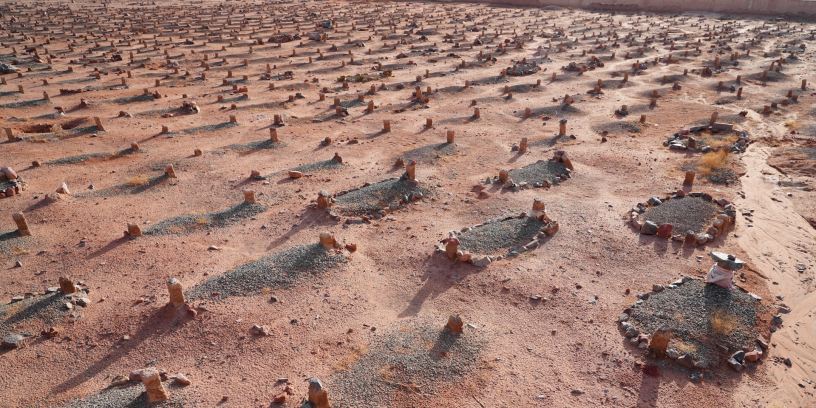
People often describe the grave as the final resting place. However, grave is not the final abode; rather, it is just a stage in our final journey. When the time of death comes, a believer’s soul is gently removed from the body – like water from a jug – whereas a disbeliever’s soul is taken out painfully – like wool from branches.
The Trials of the Grave
Once death occurs, the Quran refers to a “barrier” known as barzakh which prevents the human soul from going back to the world until the Day of Judgment: “And behind them is a barrier (barzakh) until the Day they are resurrected.” (Al-Mu’minun 23:100)
It is proven from the Hadith that there is torment of barzakh, also known as the torment of the grave, for those who committed major sins.
The grave is naturally dark inside. When a person is put into it, it squeezes them. This is evident from the following hadith: “If anyone were to be saved from the trial of the grave, it would have been Saad ibn Muadh. He was given a mighty squeezing, but then he was relaxed.” (Tabarani 10,827 – Sahih)
Saad ibn Muadh was among the most righteous of people. It is authentically stated in the Hadith that the Throne of Allah shook because of Saad’s death (Bukhari 3,803), and the angels helped carry his body to the grave as an honour (Tirmidhi 3,849 – Sahih). The fact that even he briefly experienced the squeezing of the grave warns us that no one is secure from it.
In today’s age, people’s hearts have hardened and they tend to forget the hereafter because they are too immersed in this temporary world – the dunya. The Companionsof the Prophet ﷺ (the Sahabah), such as Uthman Ibn Affan, used to fear the grave so much that they would tremble at its mention. That is because the trial of the grave has been likened in the Hadith to the fitnah of Dajjal. So, we must also fear it and prepare well for it.
The Questioning in the Grave
The Prophet ﷺ informed us that when we die, two angels named Al-Munkar and Al-Nakeer question us in the grave. One of them has black eyes while the other has blue ones. They ask three questions from the deceased in the grave:
- “Who was your Lord?”
- “What is your deen (i.e. religion and way of life)?”
- “Who is this man sent among you (i.e. Muhammad ﷺ)?” (Abu Dawud 4,753 – Sahih)
Only a true believer following the deen and having firm faith in the oneness of Allah will be able to answer these questions whereas the disbelievers will not know how to answer.
The following conversation will then occur between the true believer and the angels.
The angels: “What did you use to say about this man (i.e. Muhammad ﷺ)?”
The true believer: “He is Allah’s slave and His messenger. I testify that none has the right to be worshipped but Allah and that Muhammad is His slave and His messenger.”
The angels: “We knew you would say that.”
The grave is then expanded to 70 by 70 cubits, and becomes illuminated, thus serving as a source of peace and a reminder of Jannah for the person. The conversation then continues:
The angels: “Sleep.”
The true believer: “Can I return to my family to inform them?”
The angels: “Sleep as a newlywed, whom none awakens but the dearest of his family!”
The person is then put to sleep, remains in such a peaceful state until Allah resurrects them on the Day of Judgement.
In contrast, the following exchange takes places between the angels and someone who lacked faith and acted hypocritically in the worldly life.
The angels: “What did you use to say about this man (i.e. Muhammad ﷺ)?”
The hypocrite: “I heard people saying something, so I said the same. I do not know.”
The angels: “We knew you would say that.”
Then the earth begins to constrict such a person in the grave until their ribs are squeezed together. The person is put to sleep. However, they continue being punished through the squeezing of the grave until the Day of Judgement. (Tirmidhi 1,071 – Hasan)
Reasons for Punishment in the Grave
1) Theft
Stealing is considered a major sin in Islam. The Prophet ﷺ revealed the following regarding a man who had stolen a mere piece of garment from the spoils of war: “By the One in Whose Hand is my soul! The garment that he took from the spoils on the Day of Khaybar, when it had not yet been shared out, is burning him with fire.” (Bukhari 4,234)
2) Backbiting (Gheebah)
The Prophet ﷺ once passed by two graves and said, “These two persons are being tortured not for a major sin. One of them never saved himself from being soiled with his urine, while the other used to go about with calumnies (spreading malicious gossip).” The Prophet ﷺ then took a green leaf of a date-palm tree, split it into (pieces), and fixed one on each grave. The people asked, “O Allah’s Messenger! Why have you done so?” He replied, “I hope that their punishment might be lessened until these become dry.” (Bukhari 218)
3) Physical Impurity
As indicated by the above hadith, a person who does not clean after urinating or save himself from major impurities is similarly penalized in the grave.
The Prophet ﷺ was once shown a vision by Allah in which people were being severely punished, most likely during the life of barzakh, for various crimes, summarized as follows:
4) Neglecting the Quran and Salah
The person who studied the Quran, but then neither recited it nor acted upon it, and also neglected his obligatory Salah because of sleep, was being tormented through a huge rock constantly being thrown at his head and injuring it.
5) Spreading Lies
The person who habitually spread lies was having the side of his face, eyes, and nose being torn off with an iron hook.
6) Committing Adultery
Those who committed adultery were put into an enclosed space, naked, where a flame of fire reached them from underneath and burned them.
7) Consuming Interest
The person who earned interest-based income (or riba) was made to swallow stones which were being thrown into his mouth from afar. (Bukhari 7,047)
Who is Saved from the Torment of the Grave?
1) The Martyr
The shaheed is a martyr in the cause of Allah. Such an individual has a very high status in Allah’s sight, and their death is considered extremely virtuous. It is mentioned in the Quran, “And whoever obeys Allah and the Messenger – those will be with the ones upon whom Allah has bestowed favour of the prophets, the steadfast affirmers of truth, the martyrs and the righteous. And excellent are those as companions.” (Al-Nisa 4:69)
There are various degrees of martyrdom in Islam, such as dying due to:
- Fighting in the way of Allah
- A plague
- Drowning
- Pleurisy
- An internal complaint
- Burning
- Falling debris
- Pregnancy (Abu Dawud 3,111 – Sahih)
2) Those Stationed at the Borders
Al-Mura’bat refers to the soldiers who are stationed at posts to guard a Muslim State’s borders from the enemies. The Prophet ﷺ said, “Keeping watch for a day and a night is better than fasting for a whole month and standing in prayer every night. If a person dies (while performing this duty), his activity will continue and he will go on receiving his reward for it perpetually and will be saved from the torture of the grave.” (Muslim 1,913a)
3) Those who Die on a Friday
Someone who dies on a Friday receives special mercy from Allah, as the Prophet ﷺ informed us, “No Muslim dies on the day of Friday, nor the night of Friday, except that Allah protects him from the trials of the grave.” (Tirmidhi 1,074 – Hasan)
4) Those who Frequently Recite Surah Al-Mulk
The Prophet ﷺ said, “Indeed there is a surah in the Qur’an of thirty ayaat which intercedes for a man until he is forgiven. It is Tabarak alladhi biyadihil mulk (i.e. Surah Al-Mulk).” (Tirmidhi 2,891 – Hasan)
It is worth remembering that all goods deeds such as offering prayers, fasting, giving sadaqah, maintaining family ties, showing kindness towards strangers, etc. are a means of inviting Allah’s mercy, and therefore, can save us from the trials of the grave. Moreover, repentance to Allah (istighfar) is very important, and should be made a part of our daily life, as the Prophet ﷺ used to seek forgiveness from Allah over seventy times each day.
 Islam Explained
May Allah reward you for sharing this 🌙
LikeLike